When people search “how to rank in ChatGPT answers?”, they often assume AI tools work like search engines. They do not.
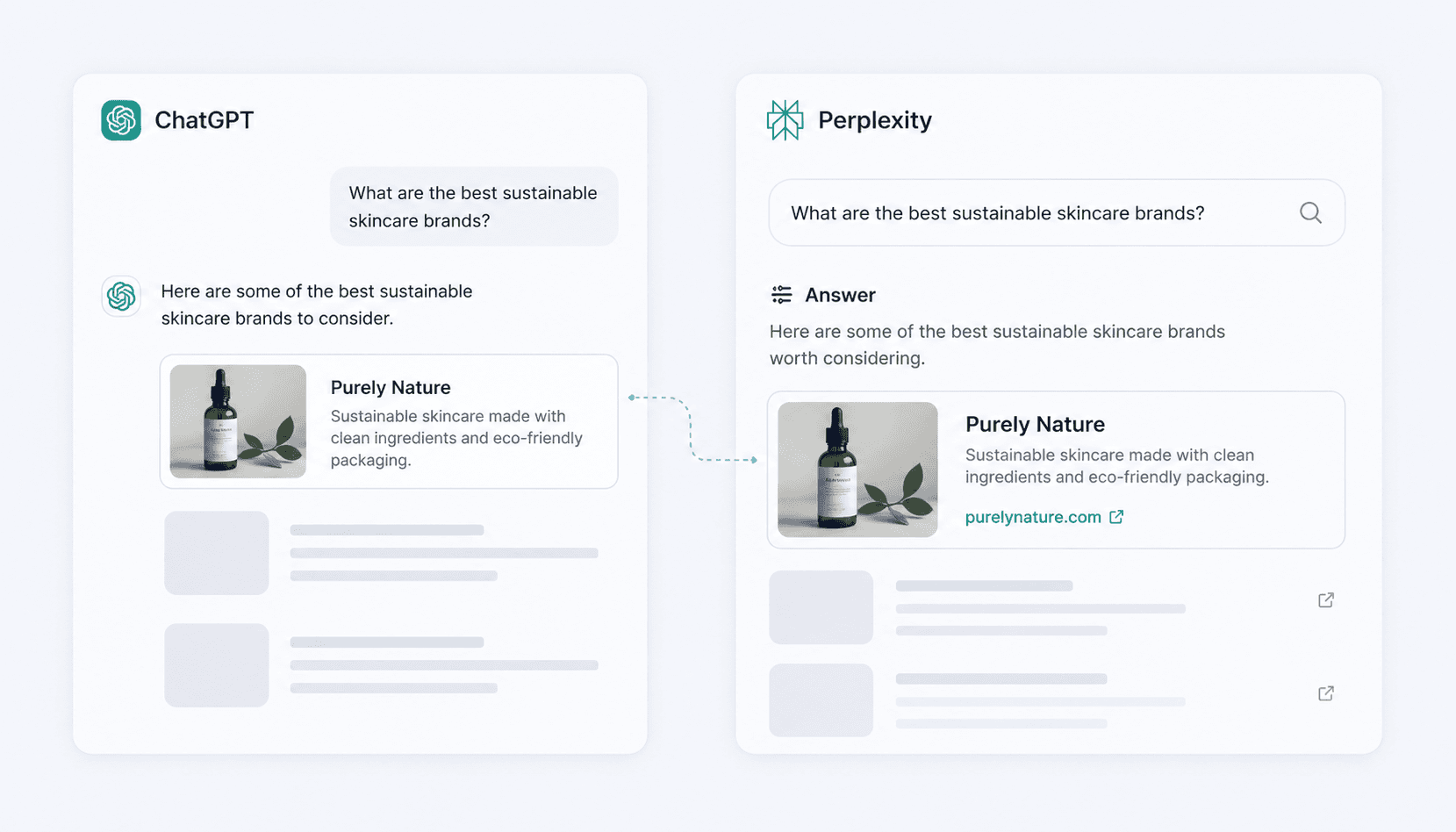
ChatGPT, Gemini, and Perplexity do not rank pages. They assemble answers by selecting passages that are clear, credible, and easily reusable.
Visibility in AI answers is not about optimisation tricks. It is about becoming a reliable source that a language model can confidently reference.
To rank in ChatGPT, Gemini, and Perplexity answers, brands must shift from traditional SEO to Generative Engine Optimisation (GEO).
Unlike traditional search, AI systems do not "rank" pages; they select referenceable passages based on clarity, credibility, and retrieval value.
To become a primary source for AI-generated responses, content must be structured into autonomous retrieval units, which are self-contained paragraphs that clearly explain concepts, reduce cognitive load, and utilise stable, entity-based definitions.
TL;DR
Ranking in ChatGPT answers is not about ranking pages. AI tools assemble answers by reusing clear, credible passages that explain concepts well
The real goal is to become referenceable. Content appears in AI answers when it reduces ambiguity, demonstrates expertise, and can be confidently reused
Most GEO advice fails because it focuses on tactics, not explanations. Schema, EEAT checklists, and volume help interpretation, but do not guarantee reuse
Generative engine optimisation works at the paragraph level. Each section should function as a complete, standalone explanation
AI systems prioritise concepts over keywords. Semantic coverage, definitions, trade-offs, and limitations matter more than repetition
EEAT acts as a trust filter for AI answers. Reasoned explanations, applied examples, and precise claims increase reuse
Entity-based clarity drives brand mentions in AI tools. Consistent association between a brand and specific ideas matters more than frequency
Structured data supports understanding but does not create authority. Clear explanations remain the deciding factor
Behaviour-led clarity outperforms trend-led optimisation. Content that mirrors human reasoning is easier for AI systems to reuse
Ecommerce brands should treat informational content as authority, not filler. Explaining buying logic and reducing confusion improves AI visibility
Appearing in AI answers requires coherence, not noise. The clearest brands, not the loudest, surface most often
Reframing the Question AI Systems Are Actually Answering
A more accurate question than “how to rank in ChatGPT answers” is this: how does a brand become referenceable in AI-generated responses?
AI systems reuse content that explains concepts clearly, demonstrates expertise, and reduces ambiguity. They do not reward repetition, keyword targeting, or promotional language.
This is why much of the existing advice on AI search optimisation feels incomplete. It assumes there is a direct ranking shortcut. There is not. For a better understanding, check how Google describes its ranking systems working together.
Why Most Advice on Ranking in AI Answers Falls Short
Most advice on ranking in AI answers focuses on surface actions such as schema, EEAT checklists, or content volume.
These steps help interpretation, but they do not explain why some content is reused and other content is ignored.
AI systems prioritise explanations that are coherent, internally consistent, and grounded in recognised guidance. Content that sounds engineered rather than explanatory is rarely reused.
This is also why copying what “worked” elsewhere often fails. AI tools are not looking for patterns of optimisation. They are looking for clarity they can trust.
What Generative Engine Optimisation Actually Means in Practice
Generative engine optimisation is not about influencing AI tools directly. It is about structuring content so it can function as a reliable building block inside an answer.
This means writing explanations that are complete, precise, and usable at the paragraph level rather than optimised only at the page level.
In practice, this requires a shift in how content is planned and written.
From pages to retrieval units
AI systems do not work with whole pages. They work with passages.
Each section must stand on its own as a complete explanation. If a paragraph cannot be reused without losing meaning, it has low retrieval value.
From keywords to concepts
Semantic SEO for ecommerce is not about repeating phrases. It is about covering the full shape of an idea.
Definitions, context, trade-offs, and limitations all reduce ambiguity and make content easier for AI systems to interpret and reuse.
EEAT for AI Answers Is About Behavioural Trust, Not Signals Alone
For AI-generated answers, EEAT functions as a trust filter rather than a ranking signal.
Expertise appears when content explains reasoning, not just outcomes. Experience appears when examples are applied rather than being abstract.
Trust appears when claims are precise, supported, and measured. AI systems reuse content that demonstrates these qualities consistently.
This is why credible references matter. Not to impress, but to validate that an explanation aligns with how authoritative sources already describe the subject.
Entity-Based SEO and Why It Matters More in AI Search
AI systems understand brands and topics through stable associations, not isolated pages.
When a brand is consistently linked to specific concepts using clear and repeatable language, that association becomes machine-readable.
This is how brand mentions in AI tools emerge naturally, without direct optimisation or promotion.
Consistency matters more than frequency. The goal is not visibility everywhere, but coherence everywhere.
Structured Data for AI Search Is Necessary, But Not the Differentiator
Structured data helps machines interpret content. It does not create authority.
Markup improves clarity and eligibility, but it cannot compensate for weak explanations. In AI-generated answers, structured data supports understanding. It does not determine reuse.
This is where many discussions around AI search optimisation become misleading. Structured data is useful, but it is not decisive.
Why Behavioural Clarity Matters for AI Visibility
AI systems favour content that reduces cognitive load.
Clear cause and effect, logical sequencing, and precise language make content easier to reuse.
Behaviour-led explanations outperform trend-led optimisation because behaviour remains stable while trends change.
This is also why content written to sound clever often underperforms. Simplicity is not a weakness in AI search. It is an advantage.
Content Citations in AI Results Come From Coherence, Not Popularity
It is a common assumption that AI answers favour only the most popular or widely cited sites. In practice, coherence matters more.
AI systems prefer sources that remain internally consistent, use stable definitions, and do not contradict themselves across sections.
This is why content clusters and internal linking strengthen AI trust. They create a connected knowledge surface rather than isolated pages.
How Ecommerce Brands Should Apply This in Real Terms
For ecommerce teams, this translates into a few practical shifts.
Category pages should explain buying logic, not just list features. Guides should reduce confusion, not chase traffic. Informational content should be treated as part of brand authority, not filler for SEO.
If you are trying to understand how to rank in ChatGPT answers, this change in mindset matters more than any tactical adjustment.
Where Most Brands Are Still Behind on GEO
Many brands already follow SEO best practices. Very few write with retrieval in mind.
This shift is consistent with Google’s recent guidance on succeeding in AI-driven search, which emphasises clarity, usefulness, and trust as the foundations of visibility in generative search experiences.
Underused practices include passage-level authority writing, explicit definition sections, and consistent terminology across content.
These practices align closely with how AI-driven search systems surface and reuse information.
This gap is not about tools or budgets. It is about how content is conceptualised.
The 3-Step Retrieval Readiness Checklist
Before publishing, audit your content against these three "retrieval-first" criteria. If a paragraph cannot pass these tests, it is unlikely to appear in a Gemini Overview.
1. The "stand-alone" passage test (chunking)
AI models like Gemini and ChatGPT perform "chunking", where they break your page into 100–300-word segments.
If a segment relies on the context of the paragraph above it to make sense, the AI will likely skip it.
Action: Ensure every H2 and H3 section starts with a declarative, noun-heavy sentence
The Check: If you copy-pasted a single paragraph into a blank document, would a reader (or a bot) still understand the core advice without reading the rest of the page?
2. Fact-density & "information gain"
AI systems are programmed to ignore "fluff" (sentences like "In today's fast-paced digital world...").
They prioritise content with high Information Gain, content that has unique facts or data points not found in every other search result.
Action: Replace abstract adjectives (e.g., "fast," "efficient") with concrete metrics or specific examples (e.g., "30% reduction in latency," "using the 2026 Schema standards")
The Check: Does this passage provide a specific, verifiable "nugget" of information that a competitor’s page does not?
3. Structural & semantic signalling
While AI is "smart," it still uses Schema.org markup as a map to find the most authoritative answers. It looks for technical signals that tell it exactly what a piece of text represents.
Action: Explicitly wrap your answers in the
FAQPageorHowToschema. Use internal links to connect entities (e.g., linking the term "EEAT" to your specific case study on it)
The Check: Is the answer to the user's intent clearly labelled for a machine? (e.g., Using a header like "How to optimise for RAG" instead of "Next Steps")
Conclusion: A Quieter Way to Think About Visibility in AI Systems
Brands that appear consistently in AI answers are not the loudest. They are the clearest.
They explain more than they promote. They align with recognised guidance. They reduce ambiguity instead of adding noise.
That is what generative engine optimisation looks like when done properly.
And that is what answering how to rank in ChatGPT answers ultimately requires.
Frequently Asked Questions
How does ChatGPT decide which sources to reference?
Does traditional SEO help with AI-generated answers?
Can ecommerce product pages appear in AI responses?
What type of content is preferred by AI search tools?