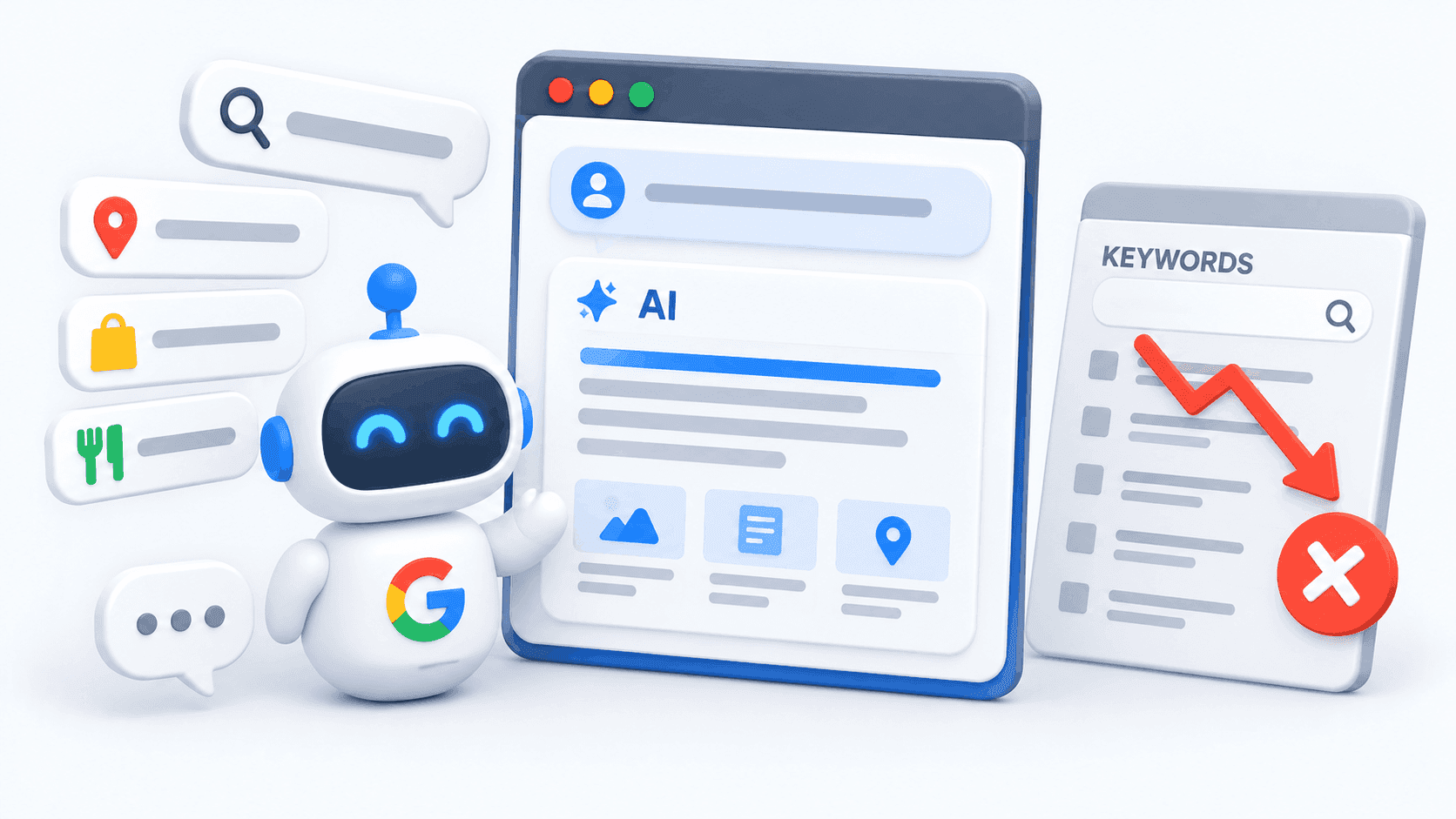
Traditional keyword SEO still helps marketers identify demand, language and intent.
What is changing is the idea that one keyword, one page and one ranking position can explain the whole search journey.
With AI-powered search, one prompt may lead to follow-up questions, several searches, comparisons and actions.
TL;DR
AI-powered search is making keyword-first SEO less effective because one prompt can lead to follow-up questions, multiple searches, comparisons and actions
Keywords still matter for identifying demand, but they should not dictate the complete structure of a page or content programme
Strong content should cover the user’s goal, decision criteria, supporting evidence and next step
Conversational search rewards clear answers and complete topic coverage, while agentic search also depends on current, usable business information
To improve visibility, focus on crawlability, originality, entity clarity, accurate commercial details and practical user journeys
Organic rankings still matter, but marketers should also track brand mentions, citations, assisted conversions and branded-search growth
What AI-Powered Search Changes About the Search Journey
Search is becoming a process that can retain context, gather information and help users move towards an outcome.
Conversational search retains context
Traditional search often requires users to reformulate each query. Conversational systems can keep relevant details as the user asks follow-up questions.
A user might ask for the best project-management tool for a small agency, then follow up about pricing, reporting and migration.
Google’s 2026 Search announcements describe this direction through follow-up questions, multimodal inputs and movement from AI Overviews into AI Mode.
The first keyword is only the starting point. Content should also support the questions that appear during comparison.
Agentic search works towards an outcome
In this article, agentic search is an umbrella term for search experiences that can complete several steps, use tools or support actions on a user’s behalf. It is not the name of one standardised product category.
Depending on the task, a system may:
Gather information from several sources
Compare products or providers
Monitor changes
Support a booking or purchase
Not every AI answer is agentic. A summary differs from a system that researches options and supports a task.
OpenAI currently describes ChatGPT Work as an agent for longer, multi-step work and finished deliverables.
One prompt can trigger several searches
Google calls this query fan-out. Its systems may run several related searches across subtopics and sources before producing a response.
OpenAI also says ChatGPT Search can rewrite requests into targeted queries and issue more specific searches after reviewing initial results.
One practical SEO implication is that a page can contribute evidence to one part of a wider research process, even when it does not repeat the user’s original wording.
For a closer look at how conversational answers are changing discovery, read How Google’s AI Overviews Are Changing the Way People Search.
Why Keyword-First SEO Is Losing Its Advantage
Keywords still matter, but exact-match targeting alone often misses the wider decision behind a query.
Keywords still reveal demand
Keyword research still reveals audience language, recurring questions, demand and organic visibility.
The mistake is treating the keyword as the complete brief. “CRM for agencies” shows interest in a category, but not whether the searcher cares most about permissions, reporting, migration or price.
Exact-match pages often fail to cover the complete decision
A page targeting “best email marketing platform” may list features but omit pricing changes, integrations and limitations.
A modern SEO strategy should organise information around decisions as well as search terms.
Rankings no longer tell the whole story
Organic rankings and clicks remain important, but users may also encounter a brand through AI Overviews, AI Mode, ChatGPT Search or generated comparisons.
Marketers should therefore evaluate rankings alongside brand discovery, assisted conversions and commercial outcomes.
What Replaces Keyword-First SEO?
A stronger model combines foundational SEO with goal coverage, decision support, evidence, entity clarity and action readiness.
Requirement | Main Question | Example Action |
Goal coverage | What is the user trying to achieve? | Map the outcome behind the query |
Decision coverage | What must the user compare? | Explain options, risks and trade-offs |
Evidence | Why should this source be trusted? | Add original data or experience |
Entity clarity | Who or what is being discussed? | Keep names and descriptions consistent |
Action readiness | Can the next step be completed? | Maintain accurate commercial information |
Cover the user’s goal and decision
A search for “SEO agency pricing” may reflect a need to compare providers, estimate risk or justify an investment.
Strong AI-powered search content should cover who each option suits, costs, trade-offs, alternatives, evidence and the next action.
Some subjects need connected resources, with each page solving a distinct part of the decision.
Provide evidence that summaries cannot reproduce
Distinctive material may include original research, first-hand tests, internal data, named expert observations, case evidence and clear limitations.
Google’s generative AI Search guidance recommends useful, unique and non-commodity content. It also says generative features remain grounded in core Search systems.
Clarify entities for people and systems
Keep company names, author details, product descriptions, services and locations consistent.
This is where optimisation for large language models overlaps with people-first information architecture. Readers and search systems both benefit from clear names, relationships and page structures.
Entity clarity can improve understanding, but it does not guarantee inclusion in an AI-generated answer.
To organise connected subjects, authors and brand information more clearly, use the Entity SEO Checklist for Bloggers: How to Build Topic Authority in Your Niche Step by Step.
Make the information actionable
Keep prices, availability, specifications, service areas, opening times and contact routes current.
As AI-powered search supports more comparisons and tasks, inaccurate commercial information can make an otherwise useful page less valuable.
How to Optimise for Conversational Search
Conversational search optimisation begins by mapping the questions that naturally follow the first query.
Map question chains, not keyword variations
Start with:
The initial question
Clarifying questions
Comparison questions
Evidence needs
Action questions
For B2B software, this may mean covering the use case before integrations, migration, pricing and implementation.
Place them on one page or across an internally linked cluster, depending on reader usefulness.
Lead with direct answers and trade-offs
Answer the main query early, then add context, evidence and limitations.
Comparison content should explain who each option suits, where it performs well and which conditions change the recommendation.
For a practical framework for structuring content around AI-generated answers, read the GEO Checklist for Content Creators: How to Optimise Your Content for Generative Engine Optimisation.
How to Prepare for Agentic Search
Agentic systems need information they can access, compare and use while supporting a task.
Keep business information current
Ecommerce brands should maintain product feeds, prices, stock details and specifications. Service businesses should keep locations, availability and contact information consistent.
Remove friction from the next action
Check whether users and browser-based agents can understand and use enquiry forms, booking systems, product selectors, checkout journeys and contact details.
Action readiness does not require redesigning a website for machines. It requires clear information and usable journeys for people.
How to Optimise for ChatGPT Search and Google AI Mode
The platforms differ, but neither publishes a guaranteed source-selection formula.
Start with shared foundations
A practical AI search optimisation programme should begin with crawlable pages, direct answers, original evidence, strong internal linking and accurate brand information.
To optimise for ChatGPT Search, make public pages accessible and publish evidence that answers real questions. Exact prompt matching is unreliable because ChatGPT Search can reformulate requests.
To optimise for Google AI Mode, follow established Search requirements while improving originality, topic coverage and business-information accuracy.
Be cautious of definitive lists of AI search ranking factors. Google and OpenAI do not publish complete formulas, and one prompt test cannot establish a universal ranking.
Use the AI Search Visibility Checklist: How to Optimize Your Content to Appear in ChatGPT and Gemini Answers to review the technical, content and authority signals that support AI-search discovery.
How to Measure Visibility in AI-Powered Search
Organic rankings remain valuable, but they should be assessed alongside discovery and business outcomes.
Continue tracking rankings, impressions, clicks and landing-page performance. Add controlled observations of citations, brand mentions and competitor inclusion across relevant prompts.
These observations are snapshots, not stable universal rankings. Measure qualified enquiries, assisted conversions, branded-search growth, product discovery and revenue influenced by organic search.
What Marketers Should Do Next
Keyword research should remain an input, not the complete structure of a content programme.
AI-powered search turns one query into a wider process involving context, follow-up questions, evidence, comparisons and sometimes action. Brands need content that covers the decision, contributes something original and makes the next step clear.
Need an organic and AI-search strategy that goes beyond keyword lists? Connect with No Fluff to build content around the questions, decisions and actions that shape modern discovery.
Frequently Asked Questions
1. What is the difference between conversational search and traditional keyword search?
2. What is large language model optimisation, and how is it different from SEO?
3. How do you optimise content for both ChatGPT Search and Google AI Mode simultaneously?